SOLD OUT. This edition was super popular and is now completely sold out. Be the first to hear about new artworks and get early access — sign up now and follow the artist.
profile width: 20 mm, Canadian Maple, White, (3x), 34 x 44 cm (External dimensions)
Nothing in Stratmann’s work is ever one-dimensional: his works unfold in layers – graphically, historically, narratively. Fine ink drawings and linguistic fragments bring a sense of meaning into the shimmering web of background…
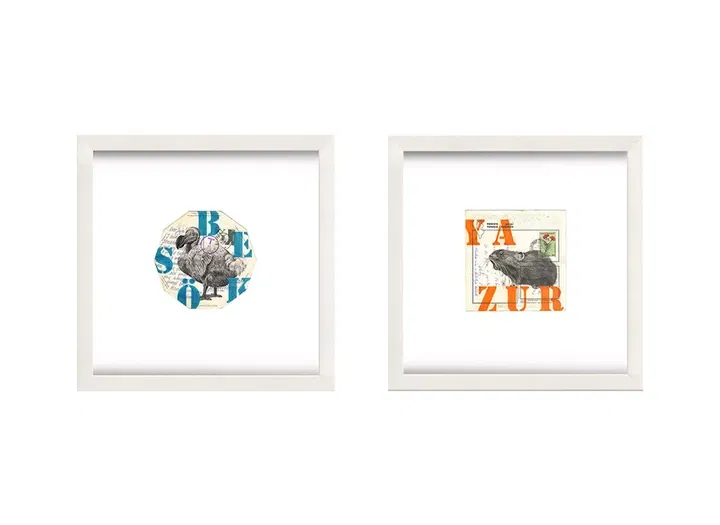
In his postcard work sets, Roland Stratmann merges drawing, language, and memory into a poetic archive of endangered species. Rendered on the written side of authentic postcards, his naturalistic animal drawings are overlaid with bold words translating to “guest” or “visitor” in the language of the postcard’s origin. Each card becomes a quiet reflection on disappearance—of species, of knowledge, of attention. The interplay between addresses, greetings, and imagery creates a web of subtle connections. Stratmann uses the postcard as a cultural carrier: personal, ephemeral, global. His works urge us to look more closely—before what matters fades from view.
BACKGROUND INFORMATION
Nothing in Stratmann’s work is ever one-dimensional: his works unfold in layers – graphically, historically, narratively. Fine ink drawings and linguistic fragments bring a sense of meaning into the shimmering web of background stories, without ever fixing them in place.
At the core of his works are what he calls “travelled postcards”: previously sent pieces of mail, marked by handwriting and daily use – small-scale records of human interaction and memory. They function as both visual relics and narrative vessels. Sourced from around the world, these postcards form the foundation of his work – in both a literal and metaphorical sense. Their creases, messages, stamps, and ambiguities are not concealed, but deliberately preserved and integrated. Some words are legible, others cryptic – inviting interpretation. These postcards blend past and present, personal and collective, documentation and composition.
On top of this base, Stratmann draws a second layer:
Ink-based interpretations of culturally and historically rich motifs – precisely rendered, yet translucent, allowing the visual memory beneath to remain visible. Stratmann chooses his references carefully: Lucas Cranach’s Adam and Eve, or Albrecht Dürer’s Rhinoceros – icons of art history, thoughtfully reimagined.
A third level runs through the works typographically:
Fragments of messages – sometimes laconic, sometimes ironic, always multi-layered. Those who read between the lines begin to see connections between the postcard content and visual composition. It’s here that the titles of his works begin to emerge.
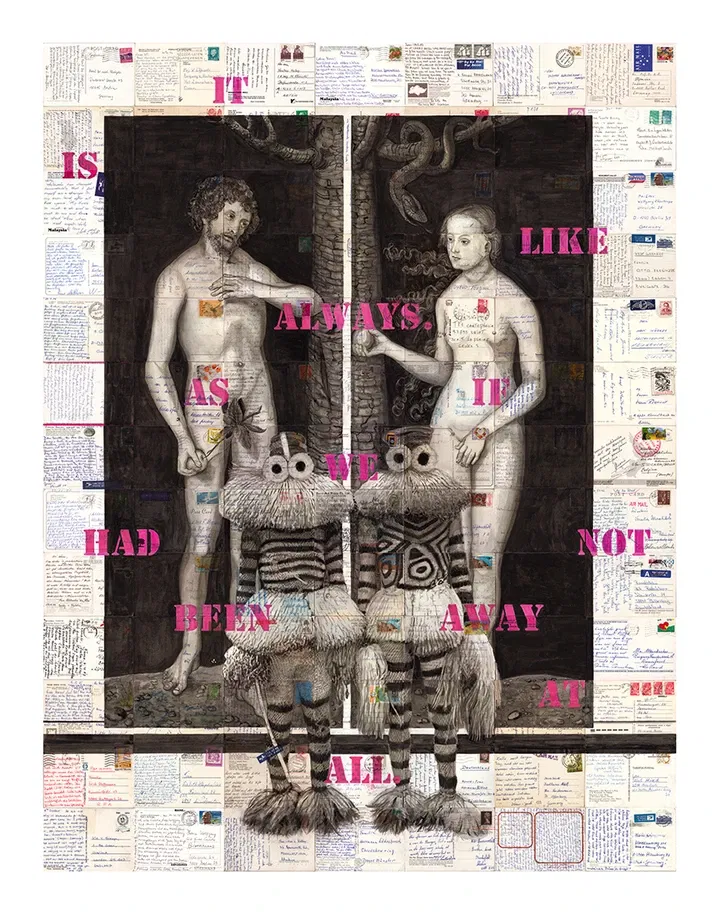
The piece Couples – Like Always refers to a Renaissance painting by Lucas Cranach depicting Adam and Eve, as well as a 1950s photograph by Eliot Elisofon showing a couple from the Boende tribe in what is now the Democratic Republic of Congo. Two couples from vastly different cultures are placed in juxtaposition – challenging habitual ways of seeing and opening space for reflection on proximity and distance, the familiar and the foreign. Across eras, geographies, and visual planes, the viewer enters into a quiet dialogue – carried, quite literally, by the subdued static of postcards that hint at stories without fully revealing them. Out of this suspension, another dialogue begins – between the artwork and the viewer’s imagination.
In Dilemma, Stratmann takes this dialogue to an interactive level:
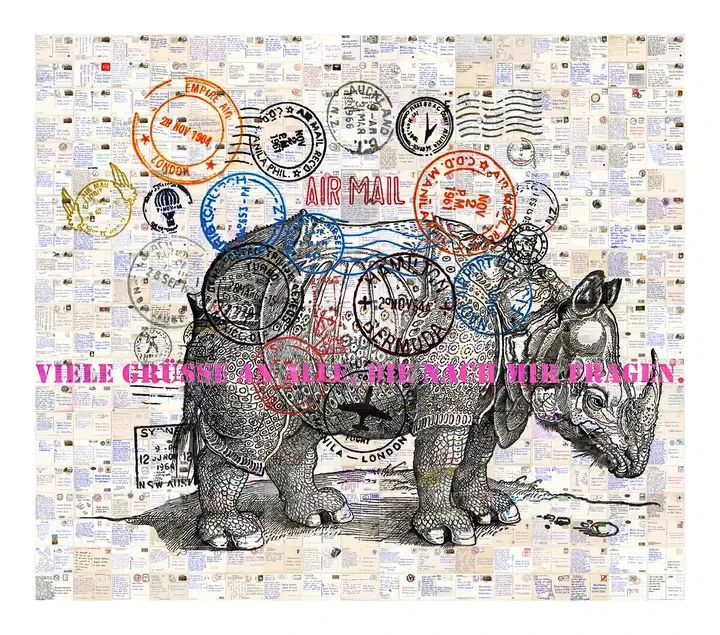
As part of an interdisciplinary project exploring crisis and design, residents of a suburb in Hamburg were invited to write postcards about personal experiences of crisis. The result: a kaleidoscope of handwritten reflections and observations that form the conceptual and visual basis of the piece.
In the foreground: an oversized ink drawing – a reimagining of Dürer’s Rhinoceros, the famed armored creature sent to the Pope in 1515, which sank en route to Rome and survived only as a woodcut that went on to circulate around the globe. Today, the rhinoceros is critically endangered.
Set against the layered voices of the postcards, Stratmann’s drawing becomes an homage to diversity – of species, of perspectives, of what moves and matters to us. Across the piece, a line of text reads:
“Viele Grüße an alle, die nach mir fragen“ – “Best regards to everyone asking about me.”
It’s a subtle, humane message – and a reminder that Stratmann’s work is a living archive of memory and meaning. You just have to look closely.
What happens when knowledge disappears?
In a series of postcard-based sets, Stratmann returns to the themes of impermanence and species extinction. Each postcard becomes a protagonist in its own right: on the message side, a naturalistic animal drawing paired with a bold text. The word, translated into the language of the card’s origin, reads “Guest” or “Visitor.” Observant viewers will find links between recipient, message, and motif – a quiet tribute to curiosity and to all that too easily fades from view.
That Stratmann works with postcards is no coincidence.
He uses them as communicative bridges – as entry points into how we understand the world.
“Every postcard sent carries a personal message into the world – and at the same time becomes part of our shared history and collective memory.”
In the handwritten traces he sees a “woven image-texture revealing the cosmos of human creativity.” And in their combined voices: a polyphonic archive of nature, culture, and time.
His work lives in this multiplicity – and from it.
He is an artist of precision, not fragility. His lines are intentional, his imagery unmistakable: never loud, but impossible to ignore. His works quietly demand attention – for what was, what is, and what risks being lost if we fail to see it.
VITA
2023
Stiftung Kunstfond NEUSTARTplus-Stipendium
2022
Stiftung Kunstfond / Neustart Kultur
2021
Artist in Residence Schloß Werdenberg, Werdenberg, St. Gallen / CH
2014
working sojourn in Malaysia
2008
working sojourn in Bolivia and Paraguay
2002/04
working sojourn in Norway and Sweden
2000
grant for Istanbul of the Senate for Science, Research and Culture, Berlin
working sojourn in Istanbul
1994
working sojourn in Southkorea
1991
Stipendium Junge Kunst, Alte Hansestadt Lemgo
1990
nomination to master degree, Universität der Künste, Berlin working sojourn in London
1984-90
Universität der Künste, Berlin
1983
Fachoberschule für Gestaltung (Technical Highschool for Design), Münster/Germany diploma/university entrance qualification
1983-90
education as lithographer, Vreden, Münster/Germany
1964
born in Weseke, lives in Berlin
Exhibitions
Solo Exhibitions
2024
sunshine at midnight, gallery at the riding arena, Castle Neuhaus, Paderborn
2023
travellers on site, gallery Schmalfuss Berlin
2022
Edenic Iconoclasts, showcase U-Zoologischer Garten, Berlin
everything worked as wished, gallery 21.06, Ravensburg
2021
Best regards from the wonderland, Richard Haizmann museum, Niebüll
WELTLÄUFIG (cosmopolitan), Art station Kleinsassen
2020
Now, C&K Galerie Berlin
2019
Parting, Exhibition Forum IG Metal, Berlin
2018
the wind always blows from the wrong direction, C&K gallery, Berlin
Dilemma, art association Buchholz/Nordheide and Kultur Kirche St. Johannis, Buchholz
Days of Grace, Galeria AT, Posen
LUMAS ART NEWS
Exclusive offers
Inspiring new releases
Personal invitations to Art Events
LUMAS protects your data. See our Privacy Policy for details.
ALMOST DONE ...
1. Open the confirmation mail.
2. Click on the confirmation link.
3. Your wishlist registration was successful!
4. Your wishlist has been saved!
We look forward to welcoming you soon to the world of LUMAS.
DIGITAL PREVIEW
SCAN THE QR CODE! (Safari IPHONE ONLY)
PREVIEW ON YOUR WALL
SCAN THE QR CODE! (Safari IPHONE ONLY)
90% of our customers order mounting or framing for a perfect gallery look.
Fully protected by our 30 day return policy.
Ready to Hang.
Elevates the artwork to true gallery quality.
Continue without mounting or framing?
* Rolled prints are final sale and cannot be returned or retrofitted with our frames





 About Roland StratmannNothing in Stratmann’s work is ever one-dimensional: his works unfold in layers – graphically, historically, narratively. Fine ink drawings and linguistic fragments bring a sense of meaning into the shimmering web of background…