SOLD OUT. This edition was super popular and is now completely sold out. Be the first to hear about new artworks and get early access — sign up now and follow the artist.
Hans Truöl understood movement before he photographed it.
As a passionate skier and mountaineer, he was as familiar with the alpine world as many of the athletes who appeared before his camera. This intimacy shapes his photographs of the Arlberg: he knew at what point in a descent tension would arise, and where he needed to position himself in order to transform speed into a powerful image.
From the early 1950s onwards, Truöl worked in and around Lech and Zürs, documenting a period in which skiing was developing at great speed and the resorts of the Arlberg were becoming internationally renowned winter-sports destinations. Figures such as Toni Sailer, Karl Schranz, and Egon Zimmermann stood before his lens. Truöl did not photograph from the detached position of an observer, however, but with the familiarity of someone who knew the terrain and the sport from personal experience. His images therefore feel immediate without appearing casual: behind the spontaneity of the moment lies an exceptionally precise eye.
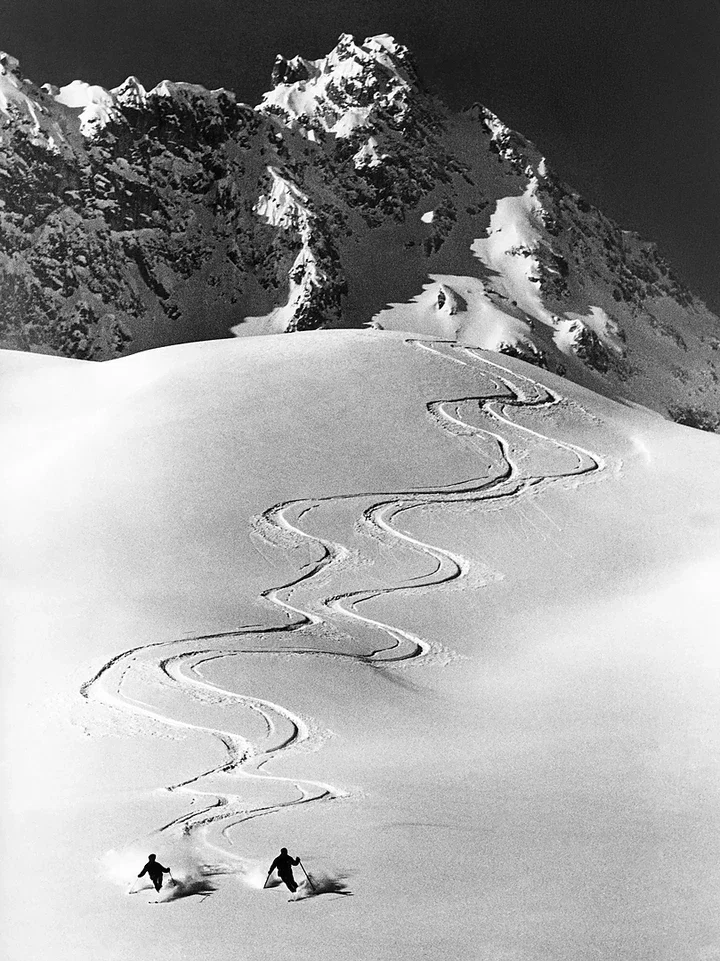
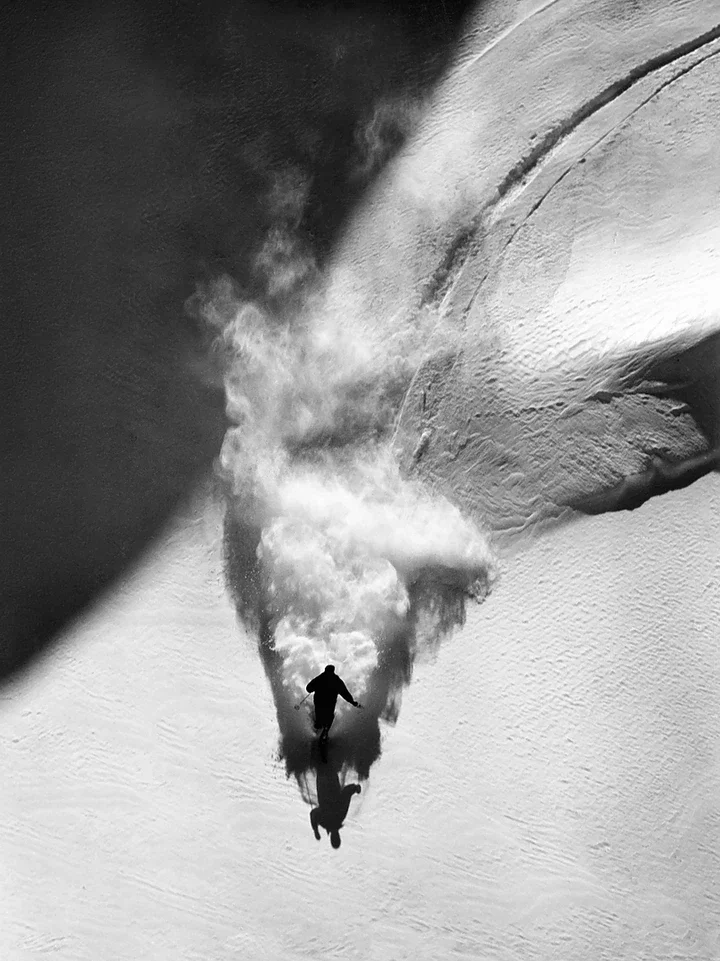
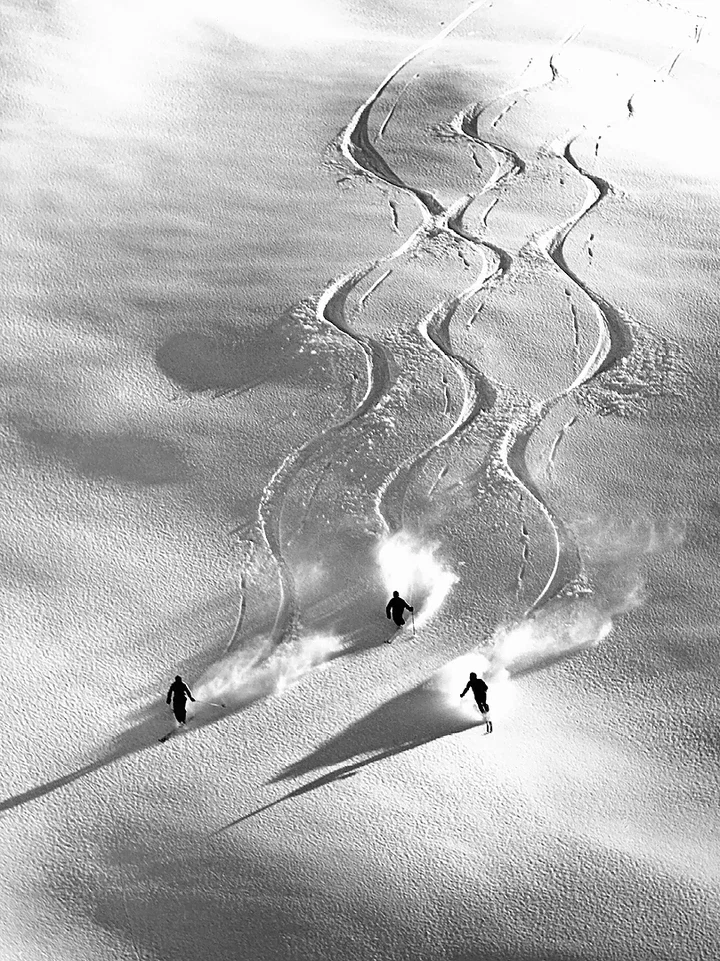
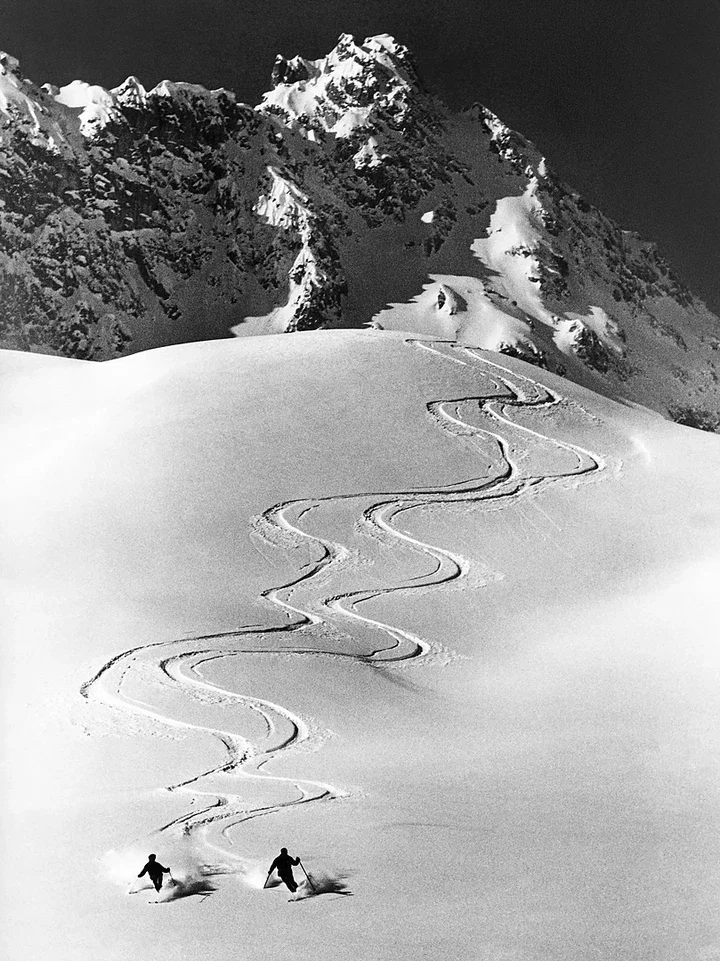
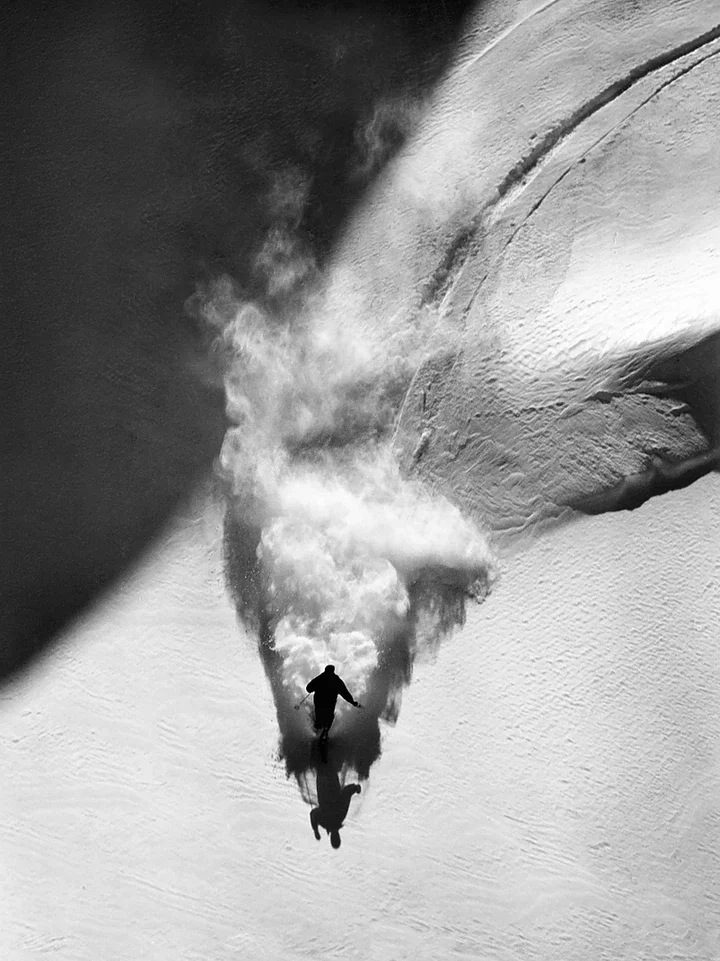
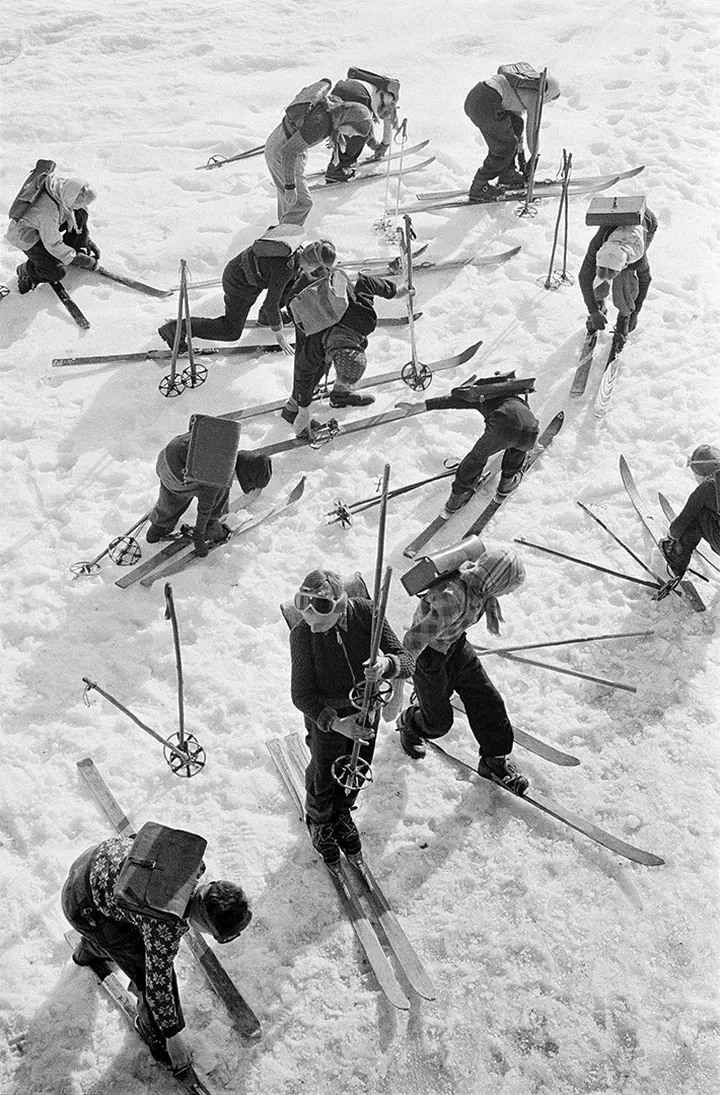
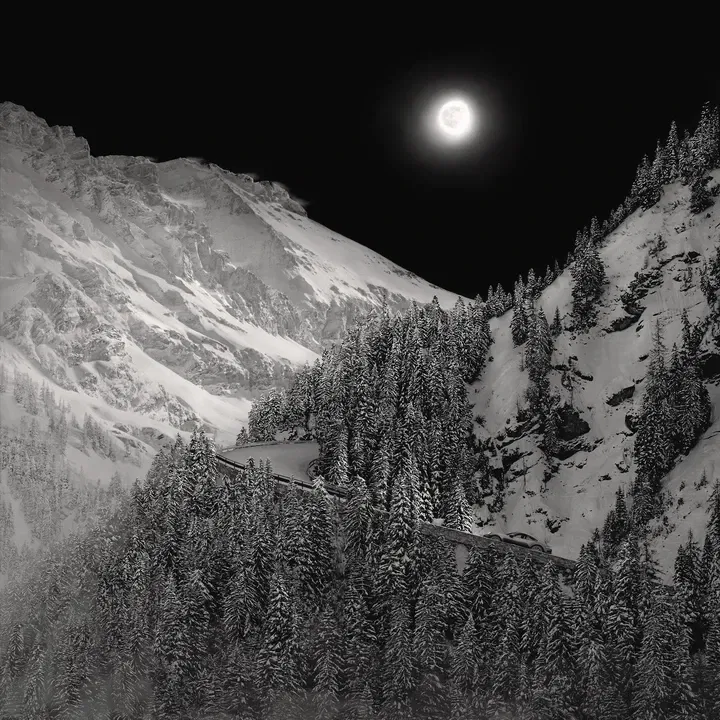
Truöl’s sense of composition is particularly evident in his black-and-white photographs. Snow reduces the landscape to bright surfaces, contours, and shadows, against which individual figures stand out all the more clearly. Ski tracks sweep across the slopes, carrying movement beyond the captured instant; clouds of powder snow almost dissolve the bodies of skiers into the landscape for fractions of a second. Truöl uses the scale of the mountains without allowing the human figure to disappear within them. It is precisely the relationship between vast expanses and small figures that gives many of his photographs their tension.
The photographs “Daredevils I–III”, created in 1958, demonstrate this quality particularly vividly. Seen from an elevated perspective, the skiers become striking points within broad expanses of snow, while their curved tracks reveal the path they have already travelled. Movement does not appear here as a blurred effect; it remains legible even though the moment itself has long since passed.
There are images that outlive their time because they preserve something time itself could not: an instant that refused to remain merely a moment.
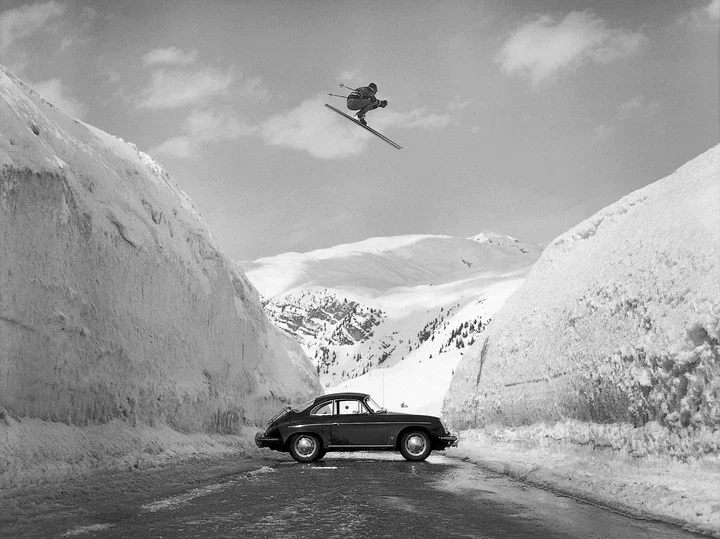
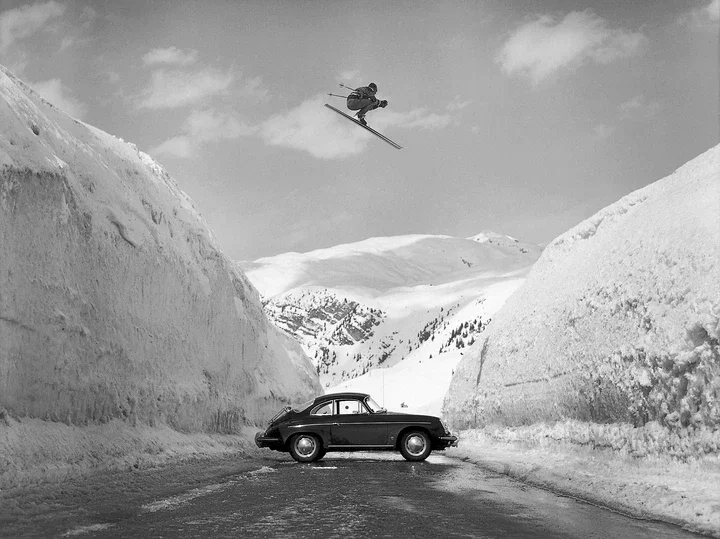
The photograph Hans Truöl took at the Flexen Pass in 1960 — a skier leaping over a Porsche standing on the ground, on a closed mountain road buried by an avalanche — is one such image. The skier hovers high above the car, while the surrounding snowfields and mountains lend the spectacular scene an astonishing sense of calm. What could easily have become a purely sensational image acquires, through Truöl’s clear composition, an almost effortless elegance.
The value of the photograph becomes especially tangible when one considers what it demanded. Truöl worked with a Hasselblad, on film, without the leniency of today’s digital sports photography, which operates in thousandths of a second and allows the photographer to choose afterwards. There was no second chance in retrospect — only the one prepared certainty at the moment the shutter was released. Photography here was not simply a record, but a wager: experience against chance, determination against the trajectory of a body in flight. That Truöl won this wager is what makes the image not a snapshot, but an assertion: that this one moment existed, and that it was worth trusting.
It is therefore hardly surprising that an image like this, much like a great song, should eventually call for a new interpretation. In 2021, Aksel Lund Svindal, choreographed by Stefan Bogner, jumped over a Neptune-blue Taycan at the Timmelsjoch — “The Porsche Jump 2.0”. A quotation, not a repetition. For what was a risk in 1960 is a homage today: proof that some images cannot be copied, only questioned anew.
Over four decades, Hans Truöl created an extensive photographic archive of alpine life. His particular sensitivity was reserved for those moments in which athletic skill, landscape, and chance briefly came together. He did not turn movement into a pose — he knew when it became a work of art.
VITA
Hans Truöl (1920–1981) was born in Augsburg and learned the craft of photography at Fotohaus Heimhuber in Sonthofen. In the early 1950s, he came to the Arlberg, where Lech and Zürs became important settings for his work. As a press, sports, and society photographer, Truöl documented the rise of alpine skiing over several decades. Among those who stood before his camera were leading figures such as Toni Sailer, Karl Schranz, Egon Zimmermann, and Willy Bogner.
Truöl was himself an enthusiastic skier, mountaineer, and Porsche driver — a personal closeness to his subjects that had a decisive influence on his work. Over the course of some four decades, he created an archive of more than 800,000 photographs. Numerous negatives and hand prints have survived, many accompanied by Truöl’s own notes on the circumstances in which they were made. His extensive body of work documents the Arlberg and the world of skiing during an era that he experienced firsthand and followed with his camera.
LUMAS ART NEWS
Exclusive offers
Inspiring new releases
Personal invitations to Art Events
LUMAS protects your data. See our Privacy Policy for details.
ALMOST DONE ...
1. Open the confirmation mail.
2. Click on the confirmation link.
3. Your wishlist registration was successful!
4. Your wishlist has been saved!
We look forward to welcoming you soon to the world of LUMAS.
DIGITAL PREVIEW
SCAN THE QR CODE! (Safari IPHONE ONLY)
PREVIEW ON YOUR WALL
SCAN THE QR CODE! (Safari IPHONE ONLY)
90% of our customers order mounting or framing for a perfect gallery look.
Fully protected by our 30 day return policy.
Ready to Hang.
Elevates the artwork to true gallery quality.
Continue without mounting or framing?
* Rolled prints are final sale and cannot be returned or retrofitted with our frames
PREVIEW ON
YOUR WALL
SAFARI ONLY. ABOUT 3 METERS DISTANCE.
PRESS START.




 About Hans Truöl
