Andreas Wolf - Pictures, Art, Photography Andreas Wolf

Andreas Wolf


Background Information about Andreas Wolf

Introduction

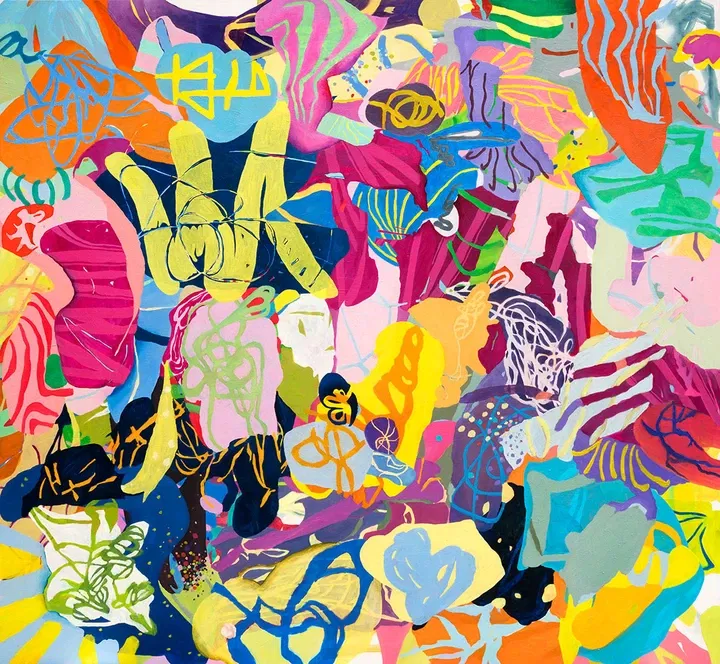
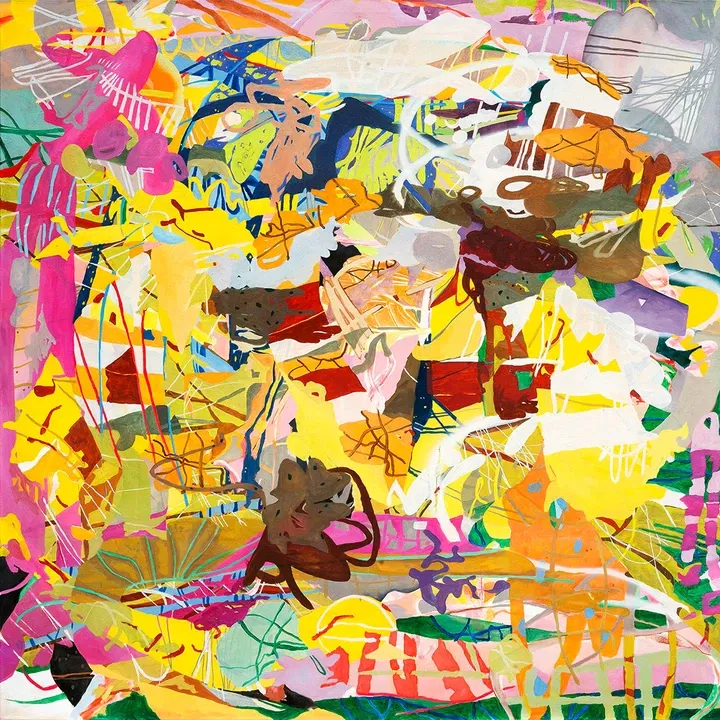
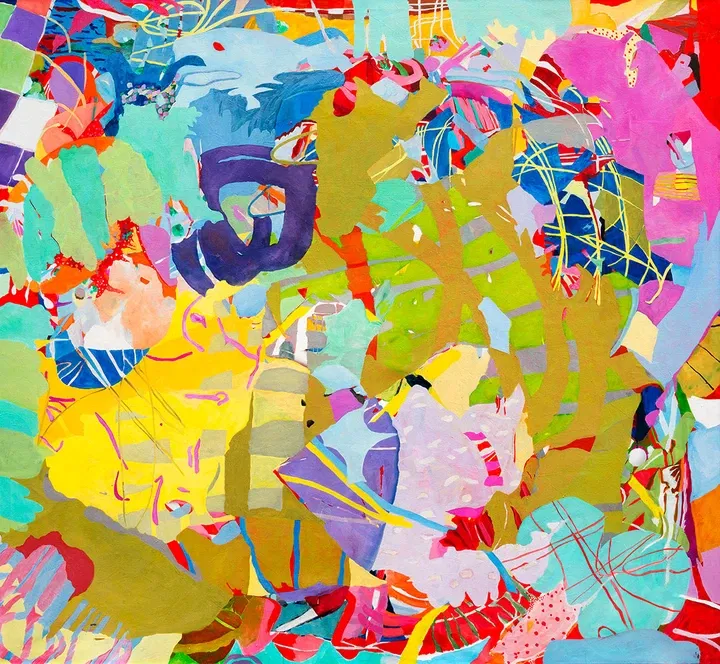
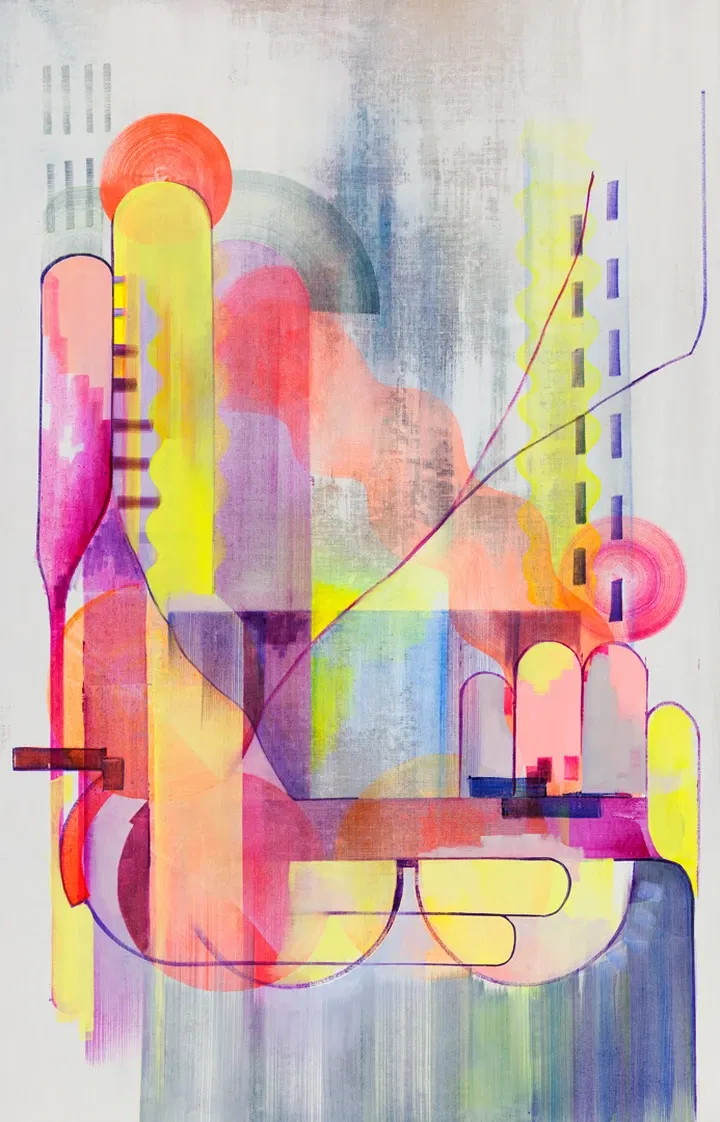
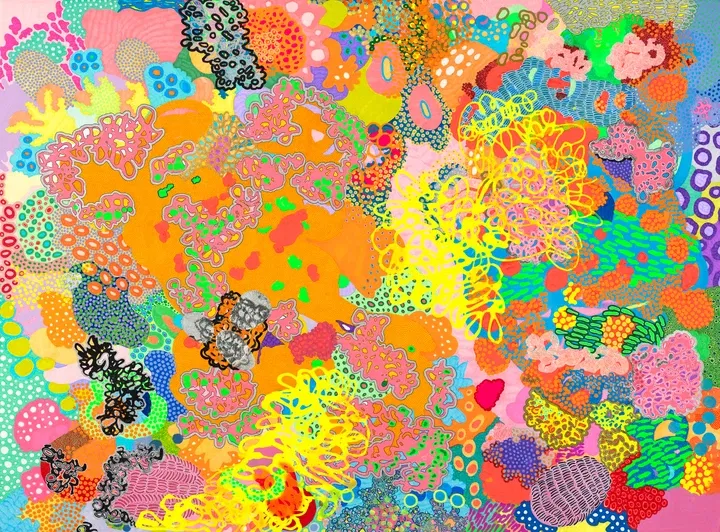
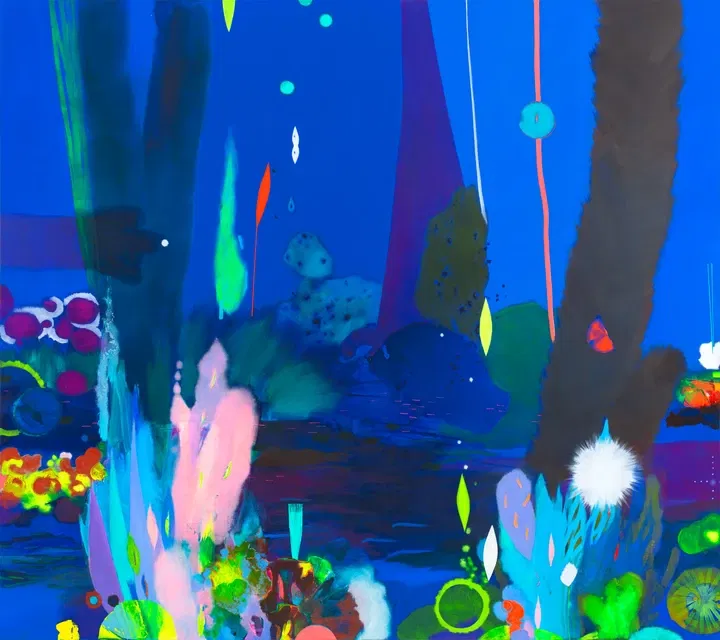
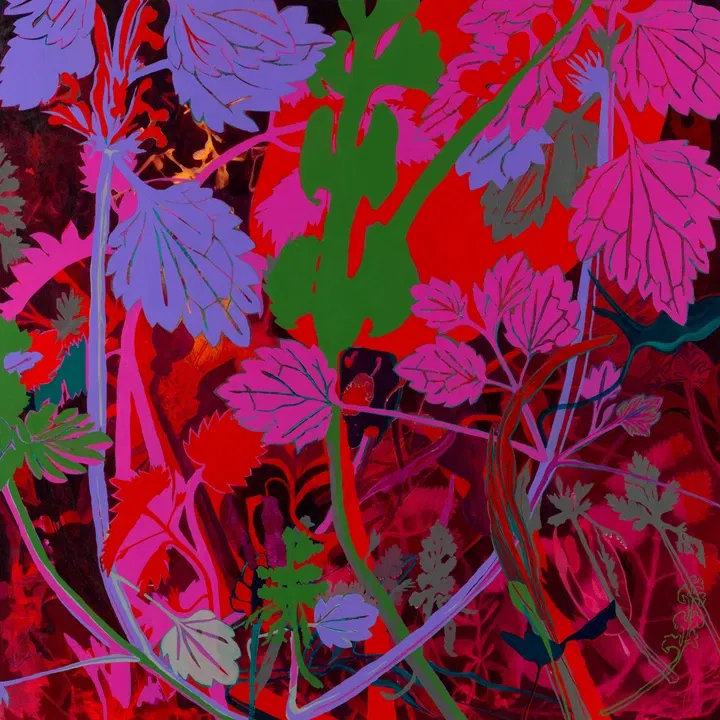
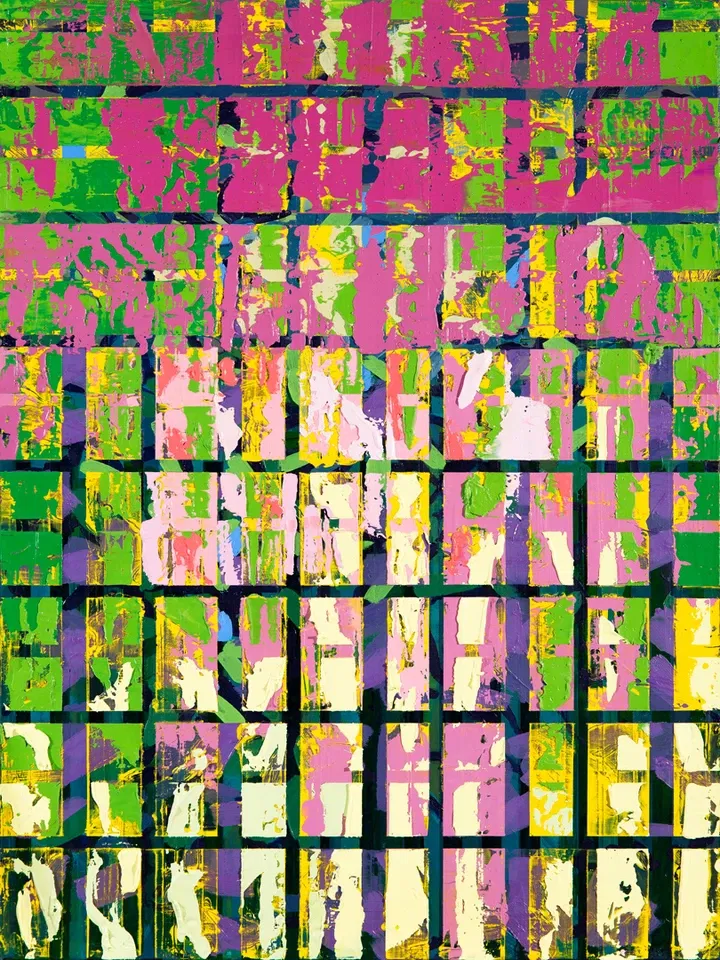
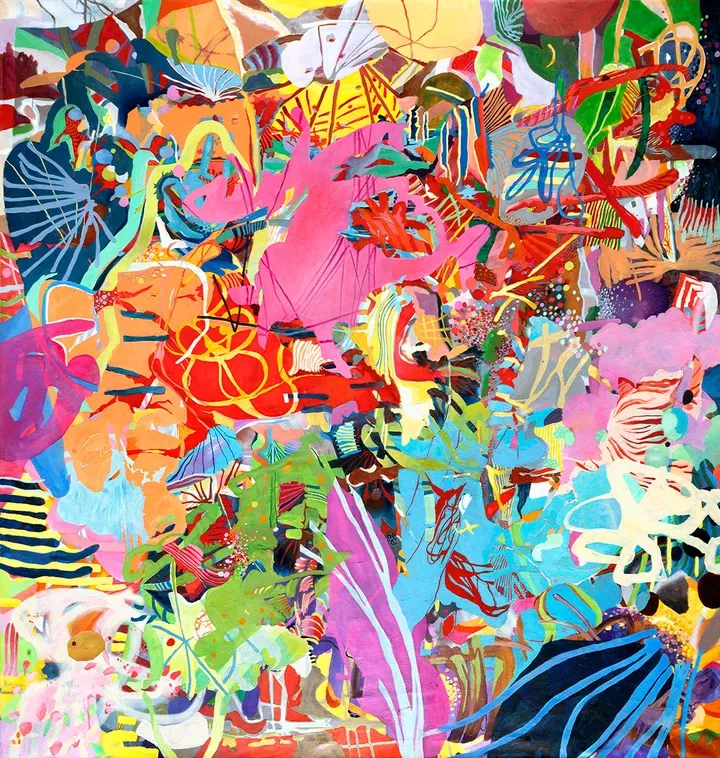
Andreas Wolf works with open-ended visual processes. His large-scale, non-representational paintings evolve layer by layer—using oil, acrylic, and spray paint on canvas. His works bear no titles and follow no narrative concept. Instead, each piece begins with a single impulse: a dot, a line, a gesture. Responding to that first mark sets a process in motion—a dialogue that unfolds over months, until the composition feels coherent in itself. A work is complete when each of its elements connects with several others—forming a dense web of visual references that continue to reveal themselves over time.


His series Fulcrum intensifies this process: the relationships within the paintings grow more intricate, and the balance between tension and composure becomes more delicate. The title—“fulcrum,” or pivot point—refers to what Wolf seeks again and again in his practice: the tipping point between order and openness, between structure and intuition.


Wolf describes painting as an act of quiet, receptive listening. He waits for the image itself to send a signal. That takes time—and a willingness to silence internal judgment. “If the image still works the next day, it’s good. If it still feels coherent a week later, it’s good. And if it still has something to say after half a year, then it’s finished,” he says. Often, it’s only in retrospect that new pathways reveal themselves: small details that emerge with distance, or new ways of moving through the work. In this way, his paintings become visual spaces that resist final interpretation—and, precisely because of this, extend beyond anything that might have been intended at the outset.


Chance and external stimuli are part of his process: the shadow cast by sunlight onto the canvas, the sudden flight of a swift through the studio, the shifting lines of a city seen during his daily bike rides—like kaleidoscopic impressions inscribing themselves into thought. Sometimes, the next compositional step already lies within the image itself—like a hidden trail that suddenly becomes visible.


What Wolf seeks is semantic openness. His painting is not about prescribing meaning, but about creating a space for experience. Viewers—often the artist himself—may discover figures, faces, or relationships within the image: sometimes fleeting, sometimes persistent. These perceptions shift, layer, dissolve. His work is not concerned with the concrete, but with the essential—with a form of freedom that refuses to settle, and in doing so, unfolds its quiet, enduring force.

Bio

The German painter Andreas Wolf, born in Heidelberg in 1965, lives and works as a freelance artist and graphic designer in Berlin. His artistic work is characterised above all by large-format, non-representational canvas paintings.
Influenced by his contact with the art scene in Heidelberg during his studies, he has been organising exhibition projects in Germany and abroad together with artists and curators since 2006. Wolf is a member of the Finnish-German project space Toolbox and on the board of the project space association Kolonie Wedding in Berlin.

Exhibitions


2022Bild Raum | Image Space, Toolbox – Finnish German Art Space Berlin

2021Prevention of rounding, Kunstverein Viernheim, Germany  
2019 Sometimes I think I could paint, Toolbox – Finnish German Art Space Berlin, with Ekkehard Vree
2018 ENDE.meins, Kulturpalast Wedding International, Berlin, with Chantal Labinski 
2016Non Objective Painting, Kolonie Wedding Project Space, Berlin 

2024NI versus AI (Natural Intelligence vs. Artificial Intelligence), Bas CS Gallery, Berlin

A B² C – Concrete Abstract 1, Galerie Wolf & Galentz, Berlin

The Spring Salon, Kuiperdomingos Projects, Art space 411 

Alles VI, Studio im Hochhaus, Berlin

Bruises, Haa Galerie, Helsinki, Suomenlinna, Finland

RE:VISION, Gallery North | Art Association Tiergarten, Berlin

Anonymous Drawers, Kunsthaus Bethanien, Berlin

10 Years KEP, Berlin

Salon Kuiperdomingos Projects / Reclaim Reality, rosalux, Berlin
2023ALLES V, Studio im Hochhaus, Berlin

Myopia, Poznan, Polen
2022B-LA Connect, Los Angeles, USA

Handgemalt und handgezeichnet, Kulturpalast Wedding International 

Fragile, Glas Fabric Riihimäki, Finland 
2021Inside Out, Gallery North | Art Association Tiergarten, Berlin

Kolonie Wedding | Berlin Contemporary Art in Romania, Centrul de interes,

Cluj, Rumänien

Vibrations, Labirynt – Festival of New Art, Słubice – Frankfurt (O) Germany – Poland, 
2020Art in the Gerichtshöfen, Berlin 

The Last Image, project space Prima Center Berlin 
2019Born to be alive, project space Prima Center Berlin 

discovery art fair Köln, XPOST Köln 

Only Echos Passing through the Night, ODETTA Gallery, Brooklyn, NY 11206 

ENERGIES & luminEscences, HLP Galerie, Wesseling, Germany 

Do Not Lean Out, Museum of Contemporary Art Vojvodina, Serbien 

Art in the Gerichtshöfen, Berlin 

Artists of Kulturpalast, Kulturpalast Wedding International, Berlin

KEP, Janusz-Korczak-library Berlin 
2018Open Studios, Kunstetagen Pankow, Berlin 

Showtime 2.0, Temporary art gallery Weinheim, Germany 

Aneignung [Appropriation] – Artists of Kolonie Wedding, Rathausgalerie Reinickendorf, Berlin 

Mr. Ira Schneider and Friends 2, project space Prima Center Berlin 

Mr. Ira Schneider and Friends, project space unter Urban Berlin 
2017Kolonie Wedding | Contemporary Art from Berlin,

Hyvinkää Taidemuseo, Finland

Narcissus, Gallery Fonticus (Groznjan, Croatia)

Nachstein, art space Toolbox, Berlin 

Emotional Circus, Undegun Art Space, Wales, Great Britain

Art Fair Suomi (Helsinki), International Contemporary Art Festival

Supermarked Art Fair, Independent Art Fair Stockholm

Interview

Picasso once said: “You don't make art, you find it.” Where do you find your art? 

I don't actually look for my art, I just try to paint pictures that I can discover something in a year's time. 

From the idea to the realization: How do you approach your work? 

I draw a line or an area of color, then react to it and in the end something may come out of it. Experience shows that at some point the pictures start to develop a life of their own, to which I react. If I control this too much, the pictures become boring; conversely, they become arbitrary if I don't really concentrate on them and if I don't give the pictures the time they need to become interesting. Visual thinking works differently to thinking in words. This is sometimes difficult to endure, but it is also very rewarding when something is suddenly just right.  

Your favorite book? 

There isn't one, but there are many that I have kept in my memory: Antonia S. Byatt: The Book of Children; Lutz Seiler: Kruso, Robert Musil: The Man without Qualities; Neal Stephenson: The Baroque Cycle; Brigitte Kronauer: The Woman in the Pillows; George Eliot: Middlemarch and Jeffrey Eugenides: Middlesex. 

Which artist would you like to have coffee with and what would you talk about? 

I would like to talk to Robert Motherwell about his use of color.  

How did you get into art? 

We had a great art teacher at school who inspired me, then I started drawing with friends and got more involved with art. 

Which people around you influence you?
 
Many, Berlin is full of interesting people, that's where I get my inspiration from, then of course from my friends and fellow artists, I also have a lot to do with Finnish artists. But my girlfriend influences me the most, she is a very good critic and a very attentive and intelligent conversation partner. She has written several texts about my paintings that have been enlightening for my work. In the last text, she wrote about the phenomenon that pictures can speak to you, that a dialog can develop with them. I experience this again and again in my work, at least when I switch off my inner censor.   

Imagine you have a time machine. Where does the journey take you? 

To the Berlin of today. 

Your greatest passion outside of art? 

I'm a big music listener. From classical music to death metal, jazz, prog rock and real-time composition. The saxophonist Harri Sjöström has been organizing the soundscapes concert series for many years, so I help a little with the organization and attend many of the concerts myself. The music scene in Berlin is great, as is the art scene. Being able to experience when music is really created and something new opens up audibly is something I can get excited about. Of course, this also happens to me in the visual arts, but the process is completely different.  

What are you currently working on?
 
A 280 x 300 cm painting. I've been tempted for a long time to work on something that exceeds my physical proportions. I want to test whether such a dimension changes the way I construct pictures. My preferred format for the larger pictures has to do with my body size, so pictures around 1.9 x 2 m (body size x arm span).